

Choosing how to build a business website affects more than its appearance. It can shape how easily you update content, add new features, manage products, and maintain the site over time.
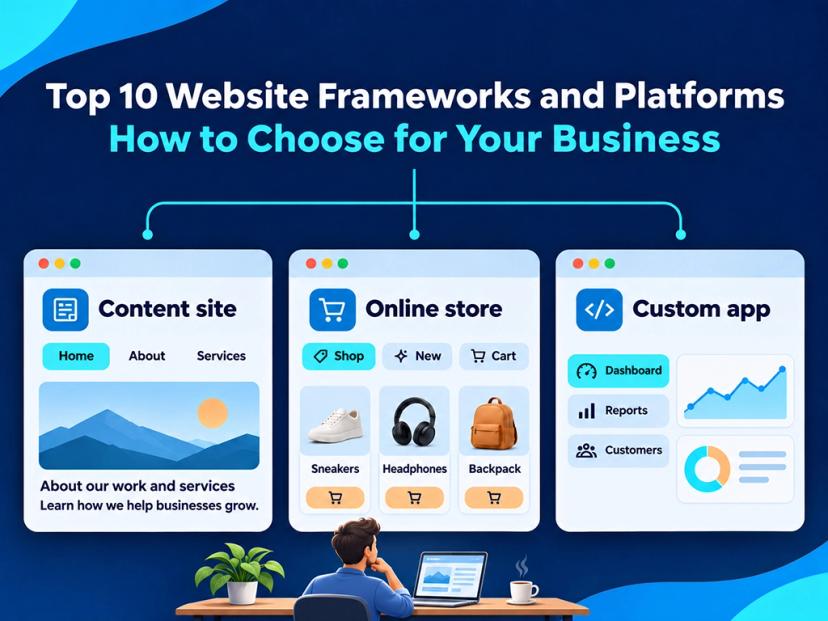
There is no single best website framework for every business. A service company that needs a polished site and a blog has different needs from an online store or a company building a custom customer portal. This guide compares ten widely used options and explains where each may fit.
A quick note: The options below are not all frameworks in the strict technical sense. WordPress is a content management system, while Shopify and Webflow are website platforms. They are included because businesses often compare them with development frameworks when planning a website.
What to consider before choosing
Before comparing technologies, write down what your website needs to do. Consider:
- Your main goal: Generate enquiries, publish content, sell products, or provide an online tool.
- Who will update the site: Your team, a developer, or both.
- Features you need: For example, a blog, booking system, customer login, or product catalogue.
- Maintenance: Who will handle updates, security, hosting, and support?
- Room to grow: Which features might you need later, and which can wait?
1. WordPress
Good fit for: Business websites, blogs, portfolios, and content-rich sites.
WordPress is a content management system that lets teams create and manage pages and articles. Themes control much of the visual design, and plugins can add features such as forms or other integrations.
It can suit a business that wants to publish content and update its own website. The number of plugins and hosting choices also means the site needs ongoing maintenance and thoughtful plugin selection.
2. Shopify
Good fit for: Businesses whose main goal is selling products online.
Shopify is an ecommerce platform for building and managing an online store. Businesses can start with a theme and customize it, or work with a developer on a more tailored storefront.
It can be a practical option when products, orders, and checkout are central to the website. If your project needs unusual workflows or a highly customized experience, clarify those requirements before choosing a theme or custom build.
3. Webflow
Good fit for: Marketing websites where visual control and content editing are priorities.
Webflow combines a visual website builder with content management and hosting tools. It lets designers build page layouts visually, while teams can manage structured content through its CMS features.
It may work well for a company that wants design flexibility and a visual editing workflow. Check that the platform’s features, hosting setup, and integrations fit your long-term plans.
4. Next.js
Good fit for: Custom websites and web applications built with React.
Next.js is a React framework with features for routing, rendering, and building full-stack web applications. It gives development teams options for creating content pages alongside more interactive features.
Consider Next.js when your project needs a tailored design, custom functionality, or a foundation that your team can extend. It requires developers to build and maintain the project, so plan for ongoing technical support.
5. Angular
Good fit for: Large, structured web applications and portals.
Angular is a web framework with tools for building and organizing applications. It can suit projects with multiple screens, forms, user roles, and complex interactions, especially when a development team wants a more structured approach.
For a small informational website, Angular may add more technical structure than the project needs. It is usually worth considering when the site behaves more like a web application.
6. Vue.js
Good fit for: Interactive website features and custom user interfaces.
Vue is a JavaScript framework for building user interfaces. It can be used for focused interactive features or as part of a larger application, depending on how the project is set up.
Vue may suit a team that wants to add custom interactions while keeping the interface component-based. The project still needs decisions about routing, content management, hosting, and other tools.
7. Nuxt
Good fit for: Vue-based websites and full-stack web applications.
Nuxt is a framework built on Vue. It provides conventions and features for organizing pages and creating websites or applications, giving development teams a fuller structure around Vue.
It may be a good fit when a project is already planned around Vue and needs features beyond a basic front-end interface. Confirm that your team has the experience to support the stack over time.
8. Astro
Good fit for: Blogs, documentation, portfolios, and content-led business websites.
Astro is a web framework designed for content-focused websites. It supports different UI component frameworks, which can be useful when a site is mostly content but needs selected interactive elements.
Consider Astro when publishing and presenting content are central to the project. If you need a complex application with frequent user interactions, compare its approach with frameworks designed around application interfaces.
9. Laravel
Good fit for: Custom websites and web applications that need server-side features.
Laravel is a PHP web application framework. It provides tools and structure for common development needs such as routing, database work, validation, and authentication.
It can be considered for custom portals, business systems, and websites with workflows that go beyond standard pages. The right choice depends on your project requirements and the development team’s experience.
10. Django
Good fit for: Data-driven websites and custom web applications built with Python.
Django is a Python web framework that includes tools for building web applications. Its features can help teams create sites that work with structured data, user accounts, forms, and administrative workflows.
It may suit a project where the website needs custom data handling or application features. As with any framework, plan for hosting, updates, security, and a developer who can maintain the code.
Which option should your business choose?
- Choose WordPress if your priority is managing pages and publishing articles.
- Consider Shopify if you primarily need an online store and ecommerce tools.
- Consider Webflow if visual design and a visual content-editing workflow are central to your site.
- Consider Next.js, Angular, Vue, or Nuxt if you need a custom interface or interactive web application.
- Consider Astro if your site is mainly content, with limited interactive features.
- Consider Laravel or Django if your project needs custom server-side logic, data handling, or user workflows.
These are starting points, not fixed rules. A developer can combine technologies, and a platform can sometimes support features you might expect to need a custom framework for. Decide based on the work the website needs to do, the team available to maintain it, and the features you actually need.
Choose for your needs, not just the trend
The right website framework or platform should support your business goals without making the project harder to manage than necessary. List your essential pages and features, decide who will update the site, and plan how it will be maintained after launch.
If you are planning a business website, online store, or custom web application, ByDev24 can help you compare the options and plan a solution around your requirements.
Call to action: Discuss your website project with ByDev24.
Frequently asked questions
Which website framework is best for a small business?
It depends on the site’s purpose and who will maintain it. WordPress can suit content-led websites, Shopify is designed for ecommerce, and Webflow offers a visual site-building workflow. A custom framework may be appropriate when you need features that a platform does not provide.
Are WordPress, Shopify, and Webflow frameworks?
Not in the strict technical sense. WordPress is a content management system, while Shopify and Webflow are website platforms. Businesses often compare them with frameworks because all can be used to build websites.
Does using a framework automatically make a website faster or better for SEO?
No. A framework provides tools and structure, but the final result depends on implementation, content, hosting, accessibility, and ongoing maintenance. A well-built site on a suitable platform can perform better for your needs than a poorly planned custom build.
Can I change the framework or platform later?
Yes, but moving a website can involve redesigning pages, migrating content, rebuilding features, and setting up redirects. Consider future needs before launch, and keep backups of your content and important data.
For help planning or building your website, explore our web development services.
Planning a website for your business?
Explore ByDev24's web development service or get in touch to discuss your project.
About the author

Written by
ByDev24
ByDev24 is a Delhi-based digital agency that builds websites, web applications, and mobile apps for businesses.